Hughes's Giant Wooden Plane Leaves the Water for 26 Seconds; Senate Asked to Count That as a Yes
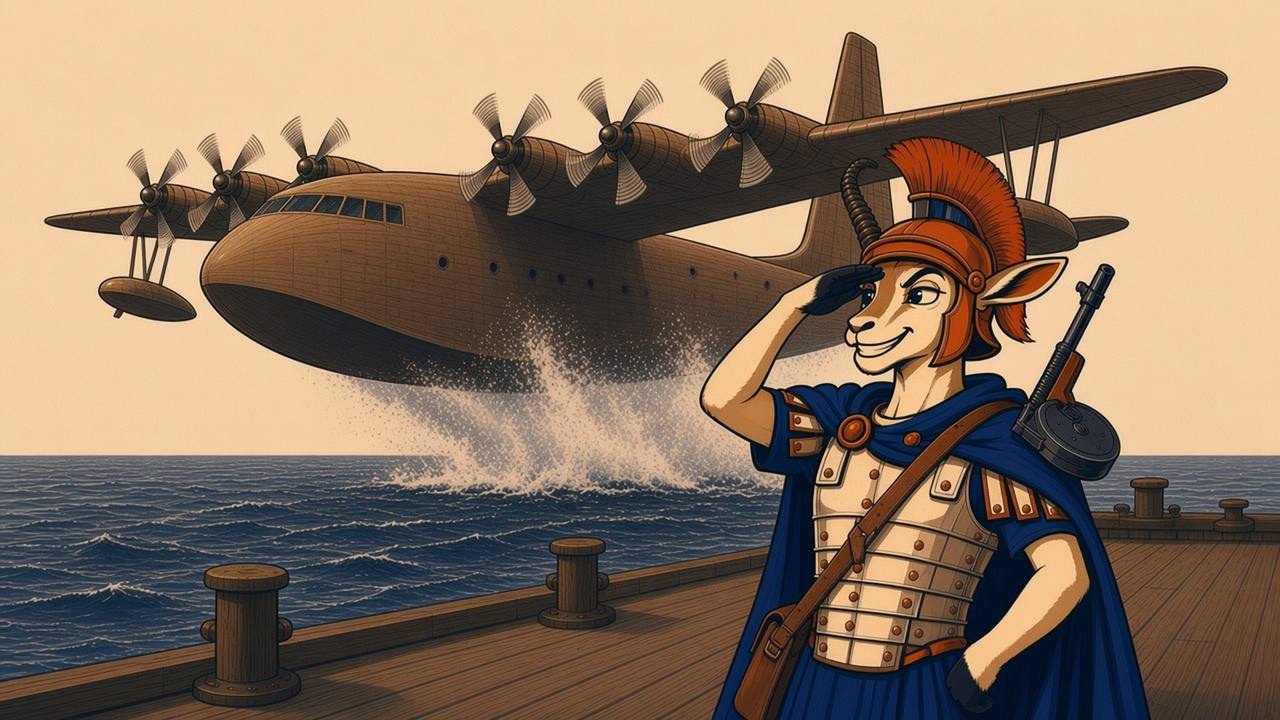
The largest airplane ever built left the surface of the harbor this afternoon for the first time, rose to roughly 70 feet, flew about a mile and set itself back down on the water, all in about the time it takes a man to finish a cup of coffee. Howard Hughes, who was at the controls, has been finishing a lot of coffee lately.
The H-4 Hercules, with eight engines and a wingspan of some 320 feet, was ordered in 1942 as a flying boat that could carry troops and cargo across an Atlantic full of U-boats, where ships kept getting sunk. The war ended in 1945. Nobody told the airplane, and it kept being built.
Today was billed as a taxi test. The first two runs stayed politely on the water, and several reporters left to file stories about a very large boat. On the third run, with dozens of people aboard, the Hercules lifted off. A crowd on the breakwater cheered. The reporters who had left are said to be reconsidering their careers.
The flight comes three months after Mr. Hughes was summoned before a Senate war investigating committee to explain what the government had gotten for its money. He told senators that the Hercules was a monumental undertaking, that he had put the sweat of his life into it, and that if it was a failure he would probably leave the country and never come back. As of press time, Mr. Hughes remains in the country.
Critics call the aircraft the "Spruce Goose," a name Mr. Hughes reportedly detests, partly because it is made almost entirely of birch. Wartime limits on aluminum pushed the design into laminated wood, producing what may be the most expensive piece of furniture in California.
Asked when the Hercules would fly again, and higher, an aide said the matter was under study. Asked whether it had really flown today, the same aide said, "Twenty-six seconds is twenty-six seconds." The Senate is expected to agree that this is mathematically true.
I Was One of the Reporters Who Left After the Second Run
I have covered aviation for eleven years. I know a taxi test when I see one. I watched the big boat go up the channel, and I watched it come back, and I said to myself, Wendell, nothing is going to happen today, and the deadline is the deadline.
I filed a lovely piece about the boat. My editor has framed it, next to the wire report of the flight, under a sign that reads LESSONS. I would like readers to know that I was right about the first two runs, which is more than the Senate can say about the last five years.
On November 2, 1947, Howard Hughes piloted the H-4 Hercules, the largest flying boat ever built (wingspan about 320 feet), during what was announced as a taxi test in Los Angeles/Long Beach Harbor. On the third run it lifted off and flew roughly a mile at about 70 feet for around 26 seconds. Ordered in 1942 as a wartime transport, first with Henry J. Kaiser, it was built mostly of laminated birch because of wartime material limits and was finished only after World War II ended. That August, Hughes had defended the program before a Senate war investigating committee, saying that if it failed he would probably leave the country. The plane never flew again. Hughes kept it in flying condition in a climate-controlled hangar until his death in 1976, and it is now on display at the Evergreen Aviation & Space Museum in McMinnville, Oregon.